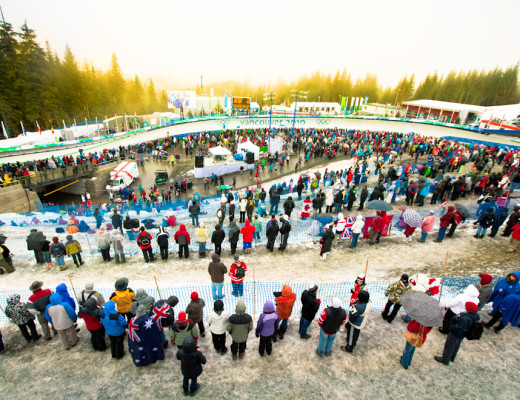
5DMKII +16-35mm f/2.8, 1/125 @ f/6.3, ISO 200.
Most photographers start their photographic journey taking photos at special events. Whether it’s a football game, a family wedding, or a rock concert, capturing the raw, spontaneous moments of these events is something all photographers aim to do.
A few weeks ago, I had the rare opportunity to photograph the Olympics in my home town. The action was happening outside my window 24 hours a day for 17 days, and as you can imagine I felt both elated and overwhelmed at the same time.
Besides learning to pace myself and charge batteries each night, I learnt some valuable lessons. Here are my top 5 tips to taking better event photos:

5DMKII +16-35mm f/2.8, 1/80 @ f/4.5, ISO 100.
1. Know what you are going to shoot before shoot it.
50% of event photography is preparation. Before you even leave the house, visualize what shots you want to take. Seems like overkill, but if you only get a few seconds chance to capture a bride walking down the aisle or a few one hundredths of a second to catch a speeding bobsled on the track, so you have to make your shots count.
I recommend writing down a shot list (e.g., wide shot of the bobsledding venue, close-up shot of some passionate fans, shot of speeding bobsled etc.) and even sketch out the important shots you want to take. If you don’t know where to start, search Flickr and the web for shots that people are taking of the event have taken at a similar event in the past.

Photo by Scott Meinzer. Me & my 5DMKII + 70-200mm f/2.8.
2. Bring the right lenses
Now that you’ve got your shot list and have an idea of what you plan on shooting, you can choose the right lenses for the job. Ideally, you want cover all your bases with a wide, mid, and telephoto lens. If you lucky to have these options then use them. And no wining about how heavy your lenses are! If you are like me and only own a few mid range lenses, consider renting a wide angle lens like the 16-35mm f/2.8 and a mid-range telephoto lens like the 70-200mm f/2.8 IS.
If you are working with a standard 18-55mm kit lens, you’ve got your wide and mid-ranges covered, but fall short on long distance zoom. You might want to bring along your point and shoot for zoom shots, or just focus on the action you can capture.

This flimsy umbrella will protect me from anything! Maybe not. :(
3. Prepare for bad weather — rain, snow, hail, world-wide apocalypse etc.
Inevitably, if you are shooting outside, it will rain, sleet, hail, or fireballs will fall from the sky. If you are unprepared, bad weather can ruin your gear, your shots, and your shoes. I learnt this the hard way when I had to trek through the slush, snow & mud at the bobsled event in tight jeans and Ugg boots with a floppy canvas bag. By mid-day I had 4 inches of freezing, dirty water in my boots and my photo bag was drenched. Luckily my 5DMKII and the 16-35mm f/2.8 were water-tight, though I did get some crazy condensation in my view finder.
Not that you’d make this same n00b fashion error, but taking a few moments to weather proof your gear and your feet is always a good idea.
Most camera bags offer some kind of water protection, but none are completely waterproof. If you want ultimate water protection, you’ll have to cart around a pelican case. Just to be safe, I always carry a spare plastic bag that fits over my camera bag just in case I get caught in a thunder storm. Smaller cameras can be sealed in plastic ziplock bags. An umbrella can be used to shield your camera when you are changing lenses and works well in snowy conditions as well.
4. Capture the story of the event
Every event has a beginning, middle, and end. Try to capture the entire story of the event. Take pictures of the empty venue and snap shots as people arrive. Show the full scale of the event. During the main event, set your camera to burst mode and shoot as many shots as you can. Bring a lot amount of memory cards. Never let space dictate how many shots you should take.
Set your camera to burst mode and concentrate on capturing the reaction of the audience, as well as the main action. Reaction shots are priceless and often capture the emotion of the event better than the actual event.
5. Get as close as you can to the action
You are never going to get those pure visceral shots if you shoot like a shrinking violet. Watching professional sports photographers at the Olympics made me realize that you really have to get close to the action to get great shots. Even with huge zoom lenses, they parked themselves right against the bobsled track, elbowing their way in, and constantly moved around to get the best shot.
During the Olympics I shot wherever I wanted to shoot without concern for whether it was “allowed” or not. In the past I’ve been so worried about getting in trouble that I’ve missed excellent shooting opportunities. I honestly think the best policy is shoot fast and furious until the cops show up.
5MKII + 16-35mm f/2.8, 1/320 @ f/5.0 ISO 250.
Many people were surprised that I was able to get so close to the bobsled track when I captured this footage of the USA-2 bobsled crash. I happened to be in the right place at the right time, but I had to really stand my ground when other photographers started trying to push in.
Share your comments & tips below!