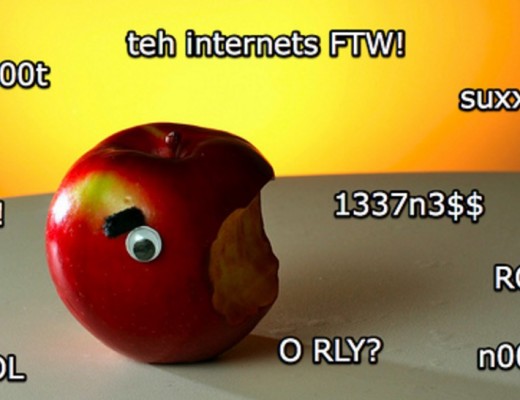
At some point during the last 10 years of this computer age, spelling and grammatical accuracy got tossed, phrases got shortened to two-finger tappables like “CU l8r”, and a whole new lexicon of ever-expanding nerd words like “w00t”, “l337″, “n00b” moved from underground Internet forums to mainstream media and your e-mail inbox.
More and more we see the Internet shaping the way we communicate with each other. The language of the Internet is fast-paced, constantly changing, and rich with cynicism and rebellion. After all, the age group developing and propagating this new iSpeak is Internet savvy teenagers belonging to Gen Z or the “Google Generation.” These kids grew up on the web, texting their friends in kindergarten, pirating mp3s for their iPods before puberty and coding complex websites during high-school geography class.
Gen Z is not afraid of breaking rules or experimenting with language. Just look at the plethora of fabulous spellings for the frequently used teen phrase “this sucks” in Internet slang, or LeetSpeak. There is “teh suxs” for everyday usage, “suxx0rz” for really bad suckage, or “suxxaga” when things just can’t suck any worse.
At first it may seem like there is no rhyme nor reason to these derivations, but like any linguistic code, it has a pattern. Once you know the pattern, it oesn’t-day, uck-say. What? No one remembers Pig Latin? Even if you are a complete n00b (“newbie”) on the Internet you will have run into your fair share of LOLs and emoticons, like this smiley, winking guy, ; ).
Whether you know the exact translation as “laugh out loud” or not, the meaning of LOL is universal. No matter where you are in the world, LOL means “I’m laughing”, while :( means “I’m sad.” This guy “:P” will get you out of a lot of trouble if you have the tendency to make snarky remarks that easily offend people — but I wouldn’t know anything about that.
The days of ruthlessly guarded spelling and grammar rules of our parents’ generation are slowly slipping away. With that being said, I am a bit of a stickler for grammar, and I’ll admit to a 50-per-cent increase in pulse rate when I see a beautifully crafted sentence like this one written on my Facebook wall: “i love your photo’s, their really good.” That was actually written by a high-school English teacher, so go figure. I’ve just had to let my Nancy Know-It-All tendencies slide a little and embrace the positives in this linguistic evolution.
So, for better or worse, the Internet is dramatically changing the landscape of human communication.
I see the evolution of language on the web as progress, rather than a slap in the face of steadfast English grammar rules. After all, we are a global community now. It’s time we start to think laterally in terms of language and communication. Plus, I never wuz a gr8 spellr anyway.
What do you think? Is our growing Internet language helping or hindering global communication?